Thursday, May 5, 2016

Sell in May? The Yen Carry Trade Sends a Warning


After having one of the worst starts in market history, equities bounced back in a big way, posting positive returns and overcoming a dreaded 10% correction. However, since the remarkable return, equities have run in to the proverbial wall as the calendar turned the page on April and set its sights on May and beyond, a period that is notorious for producing lower equity returns. But will "Sell in May and Go Away (to the Hamptons)" hold true to form in 2016 or are fears of a market slow down or worse warranted?

The Warning Signs

During bullish periods, traders often times will employ a trading technique called the "carry trade" where a trader sells one security with low yields and uses the proceeds to purchase higher yielding securities. Oftentimes the securities used are the Japanese Yen and the U.S. dollar. When the technique is being widely employed the Yen usually weakens, which is one desired outcome of the trade. The trade is completed when the Yen is repurchased with the sale of the higher yielding (hopefully) securities. The difference is the trader's profit. Therefore, a weak Yen is often viewed as confirmation of a bullish market trend. However, what happens when the reverse is true? Since the beginning of the year, the Yen has strengthened 12% against the U.S. dollar, initially confirming early weakness in equities. However, when equity markets rallied, the Yen did not confirm the bullishness and continued to climb. Was the Yen sending a signal about the strength and durability of the equity rally? It may or may not be, but recent equity weakness in the face of the seasonally weak period does not typically bode well for equity performance this summer.

It's About Earnings (and Fundamentals)

Seasonality and momentum can carry markets only so far, at some point earnings have to matter. Even though it's no secret that the Fed's hand has guided markets for years now, historically, equity performance has a high correlation with earnings performance. However, earnings have declined four quarters in a row, the first time since 2008, and equities have maintained lofty levels. At some point, something has to give. If there was a year, and season, to be cautious, it could be 2016. It's not just earnings that are acting as headwinds, falling economic indicators are painting a challenging canvas for equities to do well from current levels. Durable goods continue to underwhelm, as do consumer confidence and GDP. Although labor markets have shown resilience, wage growth continues to stagnate and payrolls actually might be about to rollover.

It's Still About the Fed...For Now

Despite the headwinds to higher equity returns, the game is still about the Fed and what it telegraphs going forward. This may not last much longer, however. Investors have been counting on weak data to suppress the Fed and its actions. Now that the market is not pricing in a June rate hike (only a 13% probability per the CME Group), weak data may start to be viewed as bad for markets, whereas, strong data may start to look like, well, strong data, and the market could interpret this as more Fed action. It's a game investors are playing but the end may be nigh as Fed options become exhausted.

Tuesday, March 8, 2016

Understanding Negative Interest Rates


The latest Central Bank tool used to combat slow economic growth are negative interest rates (NIRP). But what are negative interest rates and how does it work? For now, it's a policy being used outside of the US, in places like the Euro Zone and Japan. The Euro Zone recently went more negative while Japan went negative for the first time in its history. If the US Central Bank elects to use this policy what will it look like and how will it affect mortgage rates?

Who Uses NIRP?

The ECB, Denmark, Sweden, Switzerland and Japan are employing NIRP. The Euro Zone started using NIRP before deciding to use Quantitive Easing or asset purchases back in June 2014. Employing NIRP is a sign of economic desperation to combat deflation and slowing or falling growth. The ECB was the largest central bank to use NIRP. In January of 2016 Japan started using NIRP for the first time in its history.

Why Use NIRP?

When conventional measures to stimulate growth are not effective central banks turn to less conventional means to promote economic growth. Other non-conventional measures include asset purchases and zero-interest rate policies (ZIRP). In theory these programs are meant to stimulate borrowing and promote spending by businesses and households.

Why They Might Not be Effective

Lowering interest rates was meant to stimulate borrowing and encourage consumption by businesses and consumers. Unfortunately, businesses have not borrowed to the extent that central banks had hoped and capex has flatlined or fallen as businesses have not found the demand needed to justify investment. In regards to consumers, lower rates meant to encourage refinancing by homeowners was stifled by a lack of equity allowing for bank lending. Once homeowners successfully refinanced their homes, the savings were either put in the bank or went to pay down other debt items therefore failing to invigorate the moribund economy.

Are They Coming to the US?

NIRP is an option for the US but as of now Central Bank president Janet Yellen has not elected to employ them. If the US can hit its inflation target of 2% the Central Bank will likely not use NIRP, however, if the economy stalls and deflation becomes a threat, Janet Yellen may be forced to use NIRP. It would mean lower borrowing costs for businesses and households. Consumers will have another chance to refinance their mortgages to an even lower payment. 1% on the long bond will become a reality and mortgage rates could hit 2% on the 30-year mortgage.

Are Banks Going to Charge Consumers to Save?

As of now, this is not how NIRP is being employed. Central Banks are charging large financial institutions to park funds with them. The Euro Zone recently moved the rate it charges institutions to park money with them to -0.30%. This is meant to dissuade lenders from parking money at the Bank and to encourage them to lend it out to borrowers. Consumers are not being charged to keep money in a savings account nor are they being paid to borrow.

The Danger of Market Distortions

Analysts are critical that NIRP and other non-conventional monetary policies may have adverse effects on financial markets and may lead to further difficulties than those they are meant to solve. Obvious casualties of NIRP are lending institutions and financial institutions that rely on spreads between interest rates to make profits. Banks borrow at low rates and lend at higher rates to make profit. As interest rates come down those spreads get squished and profits fall. When rates go negative these institutions incur costs that may pass on to consumers to maintain profit margins. If not, they become less profitable. Part of a healthy economy is a healthy financial system made up of healthy banks. If they become compromised and find less incentive to lend, credit markets could suffer and markets could be facing another 2008 style calamity. This is the danger of market distortions.

Monday, January 4, 2016

2015 Market Results/2016 Outlook


Happy New Year! As we welcome the arrival of a new year it is important to look back on where we have come from. How did major markets perform in 2015? What can and should we expect in 2016?

2015 Results

Equity Indices
Dow Jones Industrials: Down 398 or 2.3%
S&P 500: Down 14.96 or 0.70%
Nasdaq: Up 271.36 or 5.6%
Russell 2000: Down 68.81 or 5.9%

Commodities
Oil: Down 16.40 or 36.6%
Gold: Down 125.90 or 11.2%
Copper: Down 0.69 or 28.1%

10-Year US Treasury
2.2694% yield up 0.10% or 4.5%

Currencies
Euro/US Dollar: Down 0.09 or 8.3%
USD Index (DXY): Up 8.32 or 808%

Summary
2015 proved to be a challenging one for money managers and all investors. Between a strong US dollar and the weakening commodities complex, returns were hard to come by as companies struggled to post positive earnings. Most asset classes were down. It paid to be diversified in overseas markets as Europe, Russia and Asia outperformed. Investors spent the entirety of 2015 fretting over the timing of the Fed's first rate hike in 8 years. The Fed's first rate hike finally came at the December meeting.

2016 Outlook

If the first trading days of 2016 are any indication, it could be another rough year for investors. Many pundits are "spinning" a bullish story based on historical performance following flat years. Last year the "story" was bullish based on the 3rd year in the presidential cycle AND positive returns during years that end in 5, like 2005 or 2015. Bulls always need a "story" or a yarn to spin and they keep churning them out. Maybe they should just stick to fundamentals, the markets do. Earnings performance are still the most reliable metric for market performance even if the market may stray away briefly.
So, what can markets look forward to in the new year?

The Fed: the market will watch the Fed closely for any indications on future rate hikes.
China: the world's second largest economy influences many economies, particularly emerging markets. The US fears further currency devaluation and its effects.
Commodities: how low can oil go? The big danger is the collapse of an entire network of derivatives connected to the commodity.
Corporate Earnings: earnings growth has slowed as well as top line revenue growth. Can stocks go up in the face of declining earnings growth?
Geopolitical Concerns: Saudi Arabia v Iran row, N. Korea testing an H-Bomb. Is North Korea a black swan?

Forecast

Given the weakness in the global economy and gradual Fed tightening, US corporate earnings will suffer dragging down stock values with them. A corresponding flattening of the yield curve as short term rates rise while long term rates sniff economic weakness and fall. The outlook for the S&P 500 should remain muted ending the year where it started the year, 2050. 10-year Treasuries will remain flat and end the year where they began the year around 2.25% with little catalyst to drive them higher as the Fed moves only impact the short end of the yield curve. Commodities such as oil will be range bound and trade between $20 and $40 ending the year at the higher end of the range as optimism improves as the year comes to a close. Gold will continue to be a safe haven and end the year higher than current levels. Copper will remain range bound as emerging market demand remains soft.

Tuesday, November 17, 2015

Will the 2015 Holidays Bring Markets Cheer?


In the aftermath of the terrorist attacks in Paris on Friday the 13th, equity markets around the globe staged impressive gains on Monday, the first trading day after the attacks. Before the tragic events in Paris, analysts and market pundits had speculated whether markets had it in them to stage a traditional "Santa's" rally this season or if markets had seen most of their gains for the year after the slump in August and September. The question is: Does the market have any more juice?

The Obstacles

History and data seem to reflect market strength during the traditional holiday season, beginning in November. The attacks in Paris represent one obstacle to positive gains this holiday, but what other hurdles must the market overcome to give investors reason to cheer?

Commodities
There seems to be a strong correlation between the price of oil and equity prices. How long will this relationship last? For the time being, weak oil means weak equities. Has oil found a bottom near $40 or will we see further weakness? Because of the correlation with equities market cheerleaders are calling a bottom in oil. So far, they have been wrong on this.
There was a time when copper was fondly referred to as "Doctor" Copper. This was because copper was considered a metric for industrial and manufacturing production because so many items used copper in the manufacturing process. So went copper prices so went markets. This relationship seems to have ended either because it never really carried any real weight or because it stopped suiting the pundits that needed a "story" for the market to rise. Regardless, copper is down 30% this year alone and reflects weak demand from major industrial countries as well as China.
Strong Returns Booked in October
The sell offs in August and September set up October for massive gains, the best month in 4 years. The S&P 500 logged a gain of 8.3% and the Dow Industrials logged a gain of 8.5%. After this impressive comeback many analyst questioned what was left in the tank for the holidays and year end. Some of the Street's biggest bulls are sticking to their early forecasts for further gains but most have trimmed their expectations. The argument is that October pulled traditional late year gains forward.
Weak Fundamentals with Healthy Valuations
Corporate earnings have been coming down raising the overall market's P/E ratio with them. With October's stellar returns the price of the overall market is not cheap and as earnings fall the market gets more and more price. Further gains are challenged by these multiples and no one, even the staunchest bulls, are calling for multiples to expand at this point as the growth required to accompany them is not visible at this point in the cycle.
The Fed's December Meeting
Futures forecast a 70% chance of a Fed rate HIKE in December. This is elevated after a strong October labor report and decent wage gains. The market wants a rate increase but will it rue what it wishes for when it finally comes? Equity gains in the face of rising interest rates is not out of the question, and maybe will come with a sigh of relief, but it's not traditional that equities rally on tightening credit.

Flat 2015

The S&P 500 was flat for the year as of this publishing. Given the headwinds and strong bounce in October, markets will likely end the year near where they currently stand. After the Fed FINALLY raises rates at its December meeting, analysts will try to forecast markets in 2016 and the future path of rates and its effect on equities. There will always be bulls and there will always be bears and the markets will do what they will.

Thursday, September 17, 2015

It's Fed Day! The "Will They Won't They?" Will Finally Be Answered

Today, Thursday September 17, 2015, is the final day of the Fed's two day meeting. This has been one of the most anticipated meetings in some time, and for good reason. Although any rate increase will be modest, the shift in policy direction and market perception will be massive, indicating the beginning of the end of easy money policies, and the start of a tightening cycle.

NO FED RATE HIKE

"Won't they!" The Fed decided to hold off on raising the Fed Funds rate at today's meeting. The move would have been more symbolic than material. Any move would have been limited and would only been a statement move that "liftoff" has begun. Today's non-action puts that off for at least another meeting, which is in October.

Was This the Right Decision

"What is the Fed afraid of?" If the U.S. economy is as strong as Yellen repeated it was over and over in her post meeting press conference, what is the Fed obsessing over? According to Yellen's comments, China's economy and market volatility influenced the Fed's decision not to raise rates at this meeting. So has the Fed introduced an additional factor in their decision making process? On the surface it appears that is what they have done. If the Fed has introduced an additional consideration, it complicates the proper equation to make policy decisions going forward. If different metrics can be introduced regarding policy decisions, it makes anticipating Fed moves nearly impossible and hinders the Fed's desire to be more transparent in its decision making process. Unfortunately, the Fed has introduced more uncertainty in to an uncertain environment and market volatility is likely to continue. Now investors get to continue to game the Fed.

Thursday, September 3, 2015

If the Market is Always Right, Why are Central Banks Meddling?

One of the first investment lessons about asset markets is that price is king, price is always right. The market will dictate what the price is for an asset. This is a basic tenet of investing in asset markets. The price may be different next year, next week or tomorrow, but today the price is right. This is something all investors agree upon. However, if this is widely held as gospel within the investing community, why are central banks around the developed world waging an unprecedented assault on global asset markets, force-feeding asset prices on markets?

ZIRP and QE

Zero-interest rate policies (ZIRP) and quantitative easing have dominated global central banks for the better part of the last seven years. The US Fed established its Fed funds rate at near zero back in December 2008 and hasn't budged since. In addition to this policy the Fed also implemented quantitative easing, or QE, its asset purchase program to keep longer term rates lower and to inject liquidity in to the marketplace. Both of these policies have been mimicked over the years by various central banks around the globe, some to a lesser extent and others to a greater extent. The latest effort taking place in Europe on  Thursday, September 3rd, where Mario Draghi, the European Central Bank's president, threatened to provide additional stimulus in the wake of the weakening Chinese economy and its potential threat to the Euro Zone's middling economy. The purpose of these policy actions is to manipulate markets. The price of assets are directly affected when the Fed makes a move. But this is normal and happens all the time, right? It is normal and the Fed and Treasury make policy decisions often in hopes to affect markets. That is why they have the ability to make policy changes. If they didn't affect markets, why bother? Although this is all true, it's the extremity and duration of the policies that are twisting markets and not allowing them to function properly.

Dislocations and Misallocations

One of the effects of all the Fed intervention is creating market dislocations. Under normal circumstances, assets price themselves as a function of other assets in the market place. For example, corporate bonds typically price at some function to US treasuries, some spread. Corporate bond prices reflect their inherent risk vs US treasuries through a spread in yield. This spread reflects the premium necessary to adequately compensate investors for the additional risk. During this latest era of easy money, these spreads have been compressed and have not represented the additional risk investors have been taking. This is a problem because it disguises the actual risk that is being taken by the investor, the creditor, and the executive boards of companies that are accessing the capital markets, and creating imbalances.

An additional symptom of the extended current policies is a misallocation of capital resources. Corporations are buying back their own stock and issuing dividends at historic rates. They are doing this financial engineering to prop up stock values and mask the absence of true business expansion through capital expenditures. Companies are not growing so the economy and GDP growth is reflecting this reality, while stock values keep rising. Another misallocation this creates is fund flows from safer investments to riskier investments, often outside of a normal investors risk profile, or better said, the "search for yield." An example of this phenomenon are retirees buying more stocks and less bonds suitable for their normal risk profile, in order to increase revenue.

Monday, June 29, 2015

Pushing On A String: Maybe More Stimulus Is Not the Answer

As Greece faces another default and global markets are mounting a unified "freak out" session, the fact that China's PBOC (Peoples Bank of China) cut rates over the weekend and markets sold off in Asia on Monday, is not getting as much attention as one would anticipate (or maybe that is the real reason markets are selling off and Greece is just a cover story). The ominous inference is that if a rate cut does not have a desired effect of boosting markets, what will? And more ominous, broadly speaking, is the concern over whether central bank stimulus has lost its impact on affecting markets.

Concerted Central Bank Easing

Like good soldiers falling in line, the world's central banks, one after the other, have participated in one of the most orchestrated global stimulus efforts in history. The fact that each central bank seems to have taken its turn at easing is too coincidental to think it was not a concerted effort by governments to stagger their efforts to get a prolonged effect from additional stimulus. This is not to say that there was absolutely no overlap in stimulus programs from different countries but the manner in which the US and Japan followed by the EU announced and implemented their plans appears very coordinated. With global rates at, near or in some cases below zero, new forms of stimulus are required. With the US, Japan and finally the EU implementing their own forms of quantitative easing (QE) that form of stimulus seems to be off the table as an option unless central banks can artfully form a different variety that markets have not seen yet. With governements venturing in to uncharted financial territory they may wonder, why not keep going? Once you've left the reservation what boundaries are you constrained by?

Zero Return World

As central banks have globally reduced interest rates to zero, capital has staged a massive hunt for yield, any yield. The equity markets and junk bond markets have been major beneficiaries of this hunt for yield. Real estate has made its own comeback, as well. Market strategists have justified higher multiples on equities as equivalent returns on corporate debt have declined. In an extreme scenario, corporate debt would yield 1.0% and stock multiples would correspondingly rise to near 100, resulting in near zero asset returns with little to no consideration of risk. In essence, central banks are responsible for creating this environment through their stimulus programs and their unintended consequences. Proponents claim that the recession was not worse because of the Fed's efforts, but that is a lazy defense that cannot be proven or disproven. The most notable impact of stimulus has been its impact on asset prices. The economic recovery has been uneven and on-going for over 7 years. Markets are a discounting mechanism so it is natural that they improve ahead of the data but to date that relationship is out of whack. In this case, the data is way behind the market's performance and is still huffing and puffing to catch up. The result: very low returns across all asset classes. The real barometer of the economy: commodities. Old gauges of a healthy economy, oil demand and copper demand, have declined. Market participants have conveniently disregarded these old markets indicators.

The Proverbial String

Outside of China, central banks cannot force their constituents to borrow, buy and invest. This is the conundrum that the US and the other developed economies face. The labor market has improved but wages are stagnant. Auto sales have stages a huge comeback but it looks like that cycle is about to end with another generation of buyers stuck in extended subprime auto loans sucking up any available consumer discretionary income. This is with interest rates at zero. If things deteriorate from here, what levers does the Fed have? There are no rate cuts left. How does the Fed encourage consumers to borrow going forward? Regulations have left the financial industry hindered and US corporations are more interested in investing in their own stock than to implement capital expenditures plans that would normally create organic economic growth. As these corporations issue debt for financial engineering, the cash remaining on the balance sheets will be needed to retire this debt as rates inevitably rise, eliminating any option for capex spending. This seems to leave the Fed in the precarious position of pushing on a string when and if it needs to battle the next inevitable financial crisis.

Tuesday, April 7, 2015

Will Anything Dent the Markets?

Today's headline on Business Insider: BANK OF AMERICA: "We're heading for an earnings
recession." This premise has been floated by more than a few analysts and business media personalities. At this point, it is the worst kept secret that a deceleration in earnings growth is being forecast by most stock analysts. The question being asked now is whether the first deceleration in earnings growth in six years will be enough to spark a correction in the stock market with other markets following suit.

It's the Economy Stupid

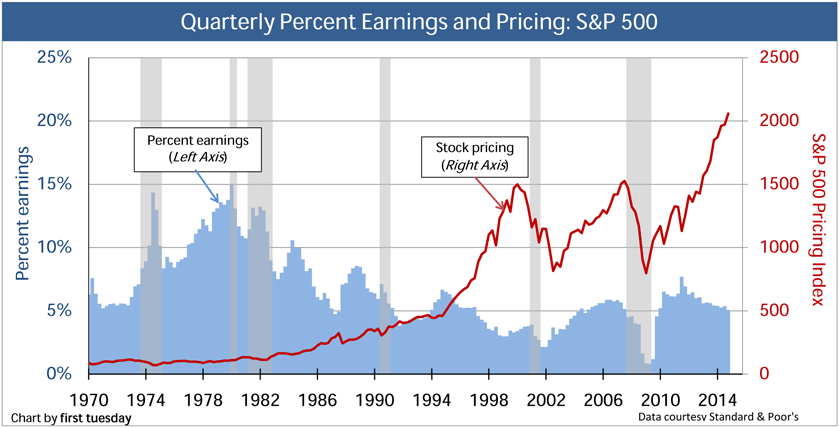
Since the depths of the recession, most observers of the stock market's six-year and counting rise, have viewed it with skepticism and a healthy dose of dubious acceptance. Record earnings growth and an accommodative Fed have contributed to the market's run with market bulls responding to the bear's cynicism by pointing out the strong earnings and low price-earnings multiples as reasons for continued optimism. Now the bulls are faced with a more sober reality: decelerating earnings and their correspondingly higher price-earnings multiples. What will the bulls point to now to justify an ever rising market? With multiples stretched beyond historical norms, asking for yet higher multiples seems unlikely. The chart to the right reflects the S&P 500 valuations (red line) versus declining
earnings (blue wave). There is a discernible departure between price and earnings growth. The only way to justify yet higher prices is a forecast for higher earnings growth going forward. But with forward earnings being reduced, how far out does the market have to look to find brighter skies? How much are investors willing to "pay up" for stocks based on distant earnings? One of the bull's popular refrains over the course of the market's recovery from its lows has been "the second half of the year looks better than the first." A recent concern, admitted by a popular market bull, was of second quarter earnings. The bull confessed that the market could get by with weak first quarter earnings but if second quarter earnings come in weak, it could present a problem for the market. Until now, each market hiccup has been offset by Fed support.

How Long Will the Market Rise on Continued Accommodation?

With earnings growth possibly turning negative, a rising market will look to Fed accommodation to provide bulls with more momentum and will give market bears fuel to feed their growing cynicism. Even market bulls concede that at least a 10% correction would be healthy. But each dip is met with more buying. When is the dip not met by sanguine buyers? Each hint that the Fed will postpone raising its rates is met with a market rally, the most recent happening after the long Easter weekend. A weaker than anticipated labor report was met with a triple digit gain in the Dow Industrials on the first day the market was open after the release of the labor report. How long can this response to the notion of lower rates for longer last? The Fed has already declared that it will be more accommodative for longer and will err on the side of caution and risk being too accommodative. It has tried to be as a transparent as possible and has avoided "surprising" the market with its policies. Although the Fed has expressed a desire to raise rates, it has also conveyed its "patience" to the market about its approach. There will come a point when investors will hit a wall and stop buying at ever higher valuations. That point is probably sooner rather than later. If earnings growth does not reverse and accelerate higher investors will baulk at paying correspondingly higher multiples as their risk profile is breached. What is the market's fair value in a permanent zero-rate environment? If investors never anticipated higher rates, what bid would they place on stocks? In a zero-rate world, a new metric would need to be used as a risk comparison. US treasuries would not be appropriate or adequate. Maybe a foreign bond rate or inflation (CPI) becomes the new risk barometer.

It's the Market Stupid

The Fed may choose not to raise rates based upon the performance of the economic data points they follow before the markets ultimately force their hand. The market has already disagreed with the rate forecast the Fed had been describing only to have their views confirmed by the Fed's actions to postpone raising. The same may prove to be true regarding when the Fed needs to raise rates. The market will be ahead of the Fed when they should raise rates. The market will not accept lower rates and will demand higher returns. This will cause rates to rise and stocks to pull back accordingly. When does this happen? As soon as the risk-return profile for investors shifts and capital flees US markets for greener pastures. Those greener pastures will have German, French, Spanish and Italian accents. As the Euro zone heals and growth improves, US capital will find its way over the Atlantic in a meaningful way. This process has already started. The ECB is in the nascent stage of its own QE program and has a ways to go, allowing for further easing and additional stimulus. If capital finds its way overseas in a meaningful way, the next dip in the US may not finds its fair share of buyers.

Tuesday, March 17, 2015

The Fed's Word Games

With the Fed meeting this week, attention is focused yet again on its statement, not its monetary tools. As many Fed followers correctly predicted, the Fed's arsenal of tools to combat weak growth and low inflation is waning, and has resulted on its increased reliance on the wording of its statements to influence and soothe markets. With rates at or near zero and the completion of its quantitative easing program (QE), the Fed has changed its approach to affecting markets focusing on communicating its intentions rather than implementing actual policies tools.

March 18, 2015 - Fed Releases Statement and Removes "Patient"

The Fed issued its statement on Wednesday and did not disappoint markets, as every market rallied as a result. Stock indices, energy, commodities, and bonds all rallied, some to record levels. What happened? Removing 'Patient' from its statement should have been bearish for markets, however, the Fed also lowered rate guidance in December, which helped soothe markets. Rallies like today's are often 'relief' rallies and can be short lived. As a result, the US 10-year treasury yield fell below 2.0%. Here is the Fed's March Dot Plot: Chart of FOMC participants of rate forecasts. The Fed cut its December rate forecast by 50 basis points. This alone has caused all markets to uniformly rally.

How Long Do the Fed's Words Alone Soothe Markets?

For the time being, the Fed is getting the benefit of the doubt. Its words alone have soothed market expectations and kept equity markets buoyed. Most analysts agree, at least, that markets are 'fairly' valued if not overvalued. At what point do values hit the proverbial wall? Is the market's magic number the reciprocal of the 10-year US treasury, the equivalent metric from the fixed income market? If the risk-free rate of return is 2.0%, then the equivalent equity multiple should be 50, a far cry from the current 16.5 that the S&P 500 trades at. Why aren't we there yet? The historical average multiple is what is holding the market back. That multiple for the S&P 500 is around 15, leaving markets a little 'pricey'. Six years in to the current bull market without a significant 10% pullback is leaving investors and analysts a little hesitant to place bigger bets on the largest indices. The latest 'story' from money managers are that small cap stocks are the next growth area within the equities universe. With lofty current multiples and in the face of higher rates, that window may be short lived, as small caps fare worse than their larger cap brethren when liquidity starts to dry up. As multiples across the investment spectrum rise, the search for yield will only intensify. No one knows when or at what levels markets seize up, but the Fed's words will not infinitely soothe away the concerns the market is bound to have. At the moment the market tunes out Fed-speak, the market will crack and the long-awaited market correction will follow.

Friday, February 27, 2015

The US Mortgage Conundrum

The housing industry has been an economic driver for the US economy for over a century. Between
the materials needed to construct real estate and the services surrounding its marketing and sale, the economic impact is broad and far reaching. When the housing market struggles, the economy as a whole may struggle. One aspect of the housing industry that is as important as any is mortgage finance. Historically, American homeowners have financed their home purchases using a traditional 15 or 30-year fixed rate mortgage offered by most lending institutions. Adjustable, or variable rate mortgages, have always been available in the US market but have made up a smaller portion of the market, roughly 10%. However, this might change as the US financial industry is experiencing seismic shifts among the players and regulations that affect residential lending.

Characteristics of Other Developed Nations' Mortgage Industries

The mortgage industry looks very different outside of the US. Two things that stand out are the types of mortgages that are widely used and the structure of the mortgage industry. Variable rate mortgages are far more common outside the US as well as more short and medium term rollover features. Government support through institutions like Freddie Mac and Fannie Mae are unique to the US mortgage industry and are far less common overseas. Default rates are lower outside of the US, where variable rate mortgages are more common, defying evidence that these loans are inherently more risky. To think that the US could learn a lesson or two from foreign nation's mortgage markets is not consistent with the lead the US typically takes in areas of finance and credit.

Housing and Banking are Flagging, Is Mortgage Finance to Blame?

While US stock markets continue to enjoy the now 6-year old bull market, this success throws in to sharp relief the weakness found in the US real estate market. While there are patches of strength in popular markets in the west and the northeast, the broader real estate market is experiencing overall weakness. Away from the success of Silicon Valley and Wall Street, which support their real estate markets, the rest of the country is not as fortunate. There have been several theories about why real estate is floundering, from a weak labor market to a preference for rentals by 'Generation Xers.' However, an obvious place to look has been ignored by many: the lending institutions. After the collapse of the subprime market and the real estate market itself, lenders of all kinds found themselves under siege by regulators and legislators looking to place blame and attempt to recover losses. The response to the crisis was to pull back and restrict credit creation. The large banks that did not go bankrupt or get absorbed by competitors, pulled in their reins and started tightening lending standards and limiting their mortgage products, such as popular home equity loans, or HELOCs (Home Equity Line of Credit).
What no one was paying much attention to was how much lenders were limiting their credit and how strict they had become. Anyone who tried to get a loan during this time, 2009-2013, knows how difficult it had become. After several years separated the crisis from the recovery, and the real estate market continued to struggle, some other specter was at odds with the market. As the Fed maintained its zero-interest rate policy (ZIRP), margins for financial institutions continued to compress. Now, years later, profit margins for banks have tightened resulting in less incentive to make the loans that were once its bread and butter. This economic reality combined with increased scrutiny and tightened regulation, has caused lenders to make the rational and logical business decision to reduce loan origination. If the profits are limited and the penalties are severe, why pursue the business?

What Is to be Done?

What can be done to invigorate this market and incentivize lenders to originate more loans? Maybe this is the wrong question. Maybe the better question is: Who can step in and fill the void in lending left by traditional lenders? If we assume tighter profit margins are a reality going forward, the answer could lie in nontraditional sources of credit that can survive and thrive on the thinner margins that exist today. One such place could be lenders such as Kickstarter or the Lending Club. Investors accustomed to thinner returns could be enticed by these margins and provide the liquidity borrowers need to fund their real estate purchases. The application process could be similar to the traditional lenders, so it would not require re-invention. One obstacle to overcome is to gain an acceptance and comfort level in this type of credit creation by the masses. One way to achieve this acceptance would be a collaboration between existing brick and mortar companies looking to gain access to this market with these new lenders. One example of this would be a partnership between Kickstarter and E*trade.

Thursday, January 22, 2015

Will QE Work in Europe?

After years of assurances and promises, Mario Draghi, the president of the European Central Bank (ECB) announced the passage of the European Community's version of quantitative easing (QE). The plan is an open-ended pledge of about 1 trillion euros to purchase both public and private bonds at about 60 billion euros per month until September 2016. Sovereign debt will require additional risk-sharing arrangements. Despite it's wide anticipation, markets from Europe and beyond cheered the move. Now that the monetary pledge has come to fruition, will it have the benefits the ECB and Mario Draghi hoped for?

Why Does Europe Need QE?

Europe needs QE for two simple reasons: to ward off impending deflation and to increase liquidity. The biggest danger the European economy currently faces are falling prices. The dangers of deflation have been well documented on this blog. Lower prices often beget lower prices which can then be disruptive to financial markets (ex: financial institutions rely on the value of underlying assets or inventory remaining stable or increasing).

Reasons It Could Work

Christine Lagarde, the president of the International Monetary Fund (IMF) has claimed that QE is already working. As she points out, the move lower in the exchange rate of the Euro proves that just the anticipation of QE has assisted the European community and its economy. The weaker euro allows European companies to be more competitive in the global marketplace. Additionally, any increase in inflation in Europe will help those economies associated with the Euro.

America as a Proxy

European bankers need only look across the Atlantic for a recent real life example of the effects of QE. The Fed initiated its version of QE in the fall of 2008. The Fed maintained its asset-purchasing program in some form over the following six years. The evidence is far from concrete but the program has been credited for keeping the American economy from slipping in to full blown depression. The main catalyst for implementing the unorthodox policy being the failure of Lehman Brothers. It is debatable whether the US would have suffered a more severe downturn in the absence of QE but most analysts concede that the program was helpful. The context under which both programs were implemented is different. The US economy was not trying to stave off deflation while that seems to be the European Union's biggest fear. Under American QE, asset prices increased creating a intended wealth effect, that helped encourage consumer spending and business capital expenditures. Despite the amount of stimulus the real economy in the US is struggling with low growth but is still the healthiest economy in a weak global environment.

Why It May Not Work

The European version of QE is more complex than its American counterpart. The European Union is comprised of 28 sovereign nations, each with its own banking system, whereas the US only had one central bank to work with. 28 different countries means 28 different political interests and clearly things get more complex from there. Figuring out how much sovereign debt to purchase from each country is a complex undertaking. Will each country benefit equally? Will each country feel the program has been handled equitably? The answers to these questions most certainly will be 'No'. How can Greece and Germany be treated equally? Adding to the complexity are the changing governments in each sovereign nation. It will be a struggle to keep up with the dynamic political terrain throughout the as of now 18-month program.

What if Consumers and Corporations Just Refuse to Spend and Borrow?

What no one seems to be addressing is the elephant in the room: What happens if Europeans are just different consumers and businessmen than Americans? Can QE really have a similar effect on different cultures? Europeans borrow and spend differently than Americans. Their mortgages are different and their housing is different. Adjustable rate mortgages are widely used and do not require being refinanced as often. Europeans aren't used to buying new cars every five years. Auto loan incentives may not induce buyers overseas like they do stateside. The corporate and business culture is different as well. European companies are restricted in their ability to fire their workers. High rates of unemployment, particularly among youth, is not unusual, so affecting employment will be muted. In the US, 10% unemployment was considered lofty, and getting it down to historical averages meant getting people back to work who could then become active consumers again. In Europe, it is harder to create more consumers from the ranks of the unemployed.

Boom or Doom?

The immediate fear in Europe regarding its QE program is that bond prices are so high the government will be buying bonds at elevated levels, not giving itself any cushion in the event of a down draft in prices. With rates at historic low levels, and in some cases negative, the ECB may not help but lose money on its purchases. The easy answer to this concern is the ECB can sit on the bonds until maturity.
Many of the concerns that will be analyzed and dissected over the next 18 months are moot. The ECB had to implement some strategy to fend off deflation and get the European Union and its economy back to growth. A weaker Euro should assist in that endeavor. Rates cannot realistically go any lower but the extra liquidity should find its way in to the economy in some form or another. Asset prices should rise and this in itself is a form of inflation and can lead to additional spending by consumers and businesses which ideally will lead to some inflation and hopefully economic growth. In the meantime, it's good theatre for the Americans.

Tuesday, December 16, 2014

The Oil Conundrum


Over the span of the last 7 months oil has fallen by over 40% and the bottom is still nowhere in sight. What has caused this epic decline and what are the implications, both financial and social, to the US and global economies?
On June 25, 2014, WTI (West Texas Crude Oil) was $102.53/barrel. Today, December 16, 2014, oil is trading under $56/barrel. The price of gasoline at the pump has fallen accordingly. One year ago the national average for a gallon of regular gas was $3.23/gallon. Yesterday that average had fallen to $2.53/gallon. The implications for US consumers is obvious. Gas price increases or decreases are widely considered either a tax or tax break for US consumers. In this case the decline at the pump is being described as a massive tax break for consumers. The questions most analysts are trying to answer is: "Are consumers spending more elsewhere now that they are experiencing some relief at the pump?"

Why Oil Prices Are Declining

Oil prices are delining because:

  • Global demand is declining
  • The US is producing an abundance of shale oil and gas
  • Speculation in energy markets has soured
  • OPEC refuses to adjust productions to today's market realities


Do the Benefits Outweigh the Costs?

Wait a minute, what costs? This is where things get cloudy for most people. How can there be costs associated with lower oil? Aren't lower oil prices a win-win for all involved? The short answer is "No." Those that sell oil and work in related fields suffer when the price of oil falls, not unlike purveyors of any product that falls in value. The tricky thing about oil is the broad benefit lower prices can have for all consumers and thus its potential economic impact nationally. The clue to whether consumers are increasing their discretionary spending to other areas could be found in the government's retail sales figures. Sales naturally will fall in the "service station" category and should increase in other categories. Will those increases be statistically significant? Will those possible increases help stimulate a moribund economy that is experiencing subpar growth for a "rebounding" economy? About those costs? A significant portion of the US economy is comprised of the energy sector. Those companies that rely on selling oil at a certain price based on their costs are adversely affected by falling prices. At some point lower prices cause these these companies to lose money which ultimately will hit their bottom lines. The result are falling stock prices and cut backs resulting in job losses and the elimination of exploration and drilling, as these become less viable endeavors to pursue.
Wall Street's biggest fear is the possible contagion associated with the banking sectors record amount of lending to the energy sector amounting to $465 billion, up 29% from the prior record in 2007, just before the "great recession". If these loans deteriorate the broader ramifications could be serious. Already equity markets are reflecting Wall Street's angst, with the S&P 500 down 3.5% this month. Flight to safety is showing up in higher bond prices, pushing the US 10-year treasury down to 2.06%. Where does this end? Presumably when oil stops falling.

The Social Implications

The reality is the social implications of falling oil are related to the financial implications. As nations (Russia and Venezuela, most notably) and individuals struggle financially from falling oil the spillover is social. Unrest has already been reported in Venezuela and how long until Russia experiences similar ills? Venezuela relies on oil revenues to make debt payments, which are coming due early next year. Putin and Russia are being simultaneously squeezed by falling oil revenues and US sanctions. How long until things break? Ostensibly, Russia has brought this on itself with its ongoing conflict with the Ukraine. Will they learn a lesson? Putin strikes me as particularly bull-headed. I would not count on him to throw in the towel for an extended amount of time, maybe when it's too late.

The Analysts' Spin

It is well understood that money managers and market analysts can never be outdone when it comes to market sanguinity, but even their "spin" is wearing thin...on each other. The story: When oil prices are rising it's because of strong global growth and markets cheer and rise. Today, while oil prices fall it's a boon for consumers and retail sales will benefit and markets cheer and rise. These stories are spooned to us from the same people. Are they speaking out of both sides of their mouths? Yes and no. Their explanation is that oil's decline is different this time. Have you heard that before? So have I. Their explanation is that oil's decline is not due to weak growth, it's due to how great America is at producing and using energy. Ok, that's fair. But, oh by the way, why is there a glut all of a sudden in oil? None of them deny that global growth has slowed and overseas demand is down. The magic wand they are using is "decoupling", that is what the US is doing. Therefore, we are immune to the global ills affecting the rest of the world. Don't believe it. We are part of the global economy and we are not immune to the world's problems. When the world coughs we will still catch a cold.

The Black Swan - No, it's NOT oil, it's actually Deflation!

I was being cute there. Sure it's oil's price decline that is the problem, on the surface. But it's really what the decline represents that is so debilitating in today's environment. Falling prices represent deflation and deflation is the enemy of capitalism and all those that live by its tenets. I have documented fully the evils of deflation on this blog but to reiterate: when prices fall people put off spending, companies can't make a profit and don't increase capital expenditures or hire people. It's nasty stuff to be sure.

The Bottom Line

As analysts come around and slowly concede that falling oil is not a completely benign event, they are assuring us that in the long run its benefits will outweigh its near term costs. I have a tendency to believe them in this regard. Given enough time, markets will acclimate to lower oil and markets will find equilibrium. This is true under any new circumstance. This is what markets do. They adjust to new realities and move on with a new calculus. This is what makes markets great. You will find few people who would argue this point.
For the time being, look for lower rates, lower commodities, and lower stocks.

Tuesday, October 7, 2014

A Strong Dollar Is A Good Problem

Money managers and TV analysts on business channels are fretting over the impact of a strong dollar
on earnings and therefore the stock market. However, a strong dollar is a vote of confidence for the US economy and should be viewed as such, with a longer term benefit to equity markets.

Why Is The US Dollar Strengthening In The First Place?

Nothing is as simple as it seems, or is it? Economies outside of the US are struggling and on a relative basis, the US economy is doing well. The US economy is not going gangbusters but the Fed is on the doorstep of tightening, whereas the rest of the world's central banks are in the midst of loosening policies. With other advanced economies like Japan and the Eurozone lowering interest rates and, as a result, devaluing their currencies, the dollar is strengthening by default. With the US dollar ostensibly acting as the world's currency, the US dollar cannot weaken itself against itself while other currencies can devalue themselves against it. As long as the US economy outperforms on a relative basis, the US dollar should continue to strengthen.

A Strong US Dollar is Good For The US Economy

Despite the consternation of myopic money managers and analysts, a longer term perspective of the economy is more favorable with a strong US dollar. It signifies a strong US economy which will ultimately feed the "virtuous cycle" the economy needs to grow and expand. A stronger economy means healthier companies, creating more jobs for consumers, who will ultimately benefit from a stronger currency in their pockets when they go to make purchases of all kinds. It means the paychecks they receive will go further, particularly considering the commodities that are part of the cost structure they live under, will be cheaper. For example, the consumers' stronger dollar means cheaper oil which equates to cheaper gas at the pump, leaving more discretionary income for these same consumers.

Whither Multinationals?

The primary debate revolves around the performance of large multinational corporations that make up the S&P 500 and the Dow Industrials. As the theory goes, a strengthening US dollar will make the products of US based multinationals too expensive for non-US consumers as those currencies weaken against the US dollar. As those products get more "expensive" abroad it will dent the demand and ultimately hit the bottom line of the large multinationals. This is not necessarily the case as these companies make the end product overseas and price them in the fiat currency of the host nations. To the extent that US multinationals are using the strong dollar to keep costs down, weaker sales should be mitigated accordingly.

Even Better For Domestic Companies

For companies that sell most of the their products and services domestically, a stronger US dollar is a boon. This narrative feeds right in to the "virtuous cycle" theory. A cheaper cost structure combined with a healthier consumer means improved margins and better sales.

History Is On Our Side

Historically, the greatest periods of prosperity in the US have been accompanied by a similarly strong US dollar. Strong global economies do not have weak currencies. Runaway inflation has never been associated with a healthy economy. Argentina is a good case study of a weak economy with runaway inflation. During times of financial crisis, foreign currencies will flow to the US dollar causing it to strengthen.

Wednesday, September 10, 2014

Back From Vacation, Will Senior Traders Take Control of Markets?

August is famous for senior Wall Street traders vacating their desks for their younger brethren and seeking the solace and serenity of the Hampton's and its beaches. Their return after Labor Day is regarded as akin to 'the adults are back' and the market will find its true direction as a result. Most analysts discount market behavior during their absence. Trading volume is typically thinner than the rest of non-holiday trading sessions and, as a result, market volatility can and does increase. As the more senior members of trading firms make their way back, volumes usually increase and the direction of stocks and bonds for the rest of the year can be better gauged. Will this year be any different or will tradition hold to form?

The Fed's Eventual Exit

This fall will be different than recent falls. This year will see the end to the Fed's Quantitative Easing program. In October, the Fed will eliminate its asset-purchasing program by reducing purchases by $15 billion. The market has not had a fall season without some form of Fed intervention since 2008. Already, the market is witnessing some turbulence. Yields on the US 10-year treasury have backed up about 25 bps, and since hitting the 2,000 milestone in late August, the S&P 500 has hit the proverbial wall. This year, the only evidence reflecting the return of senior staff may be increased volumes. The other dynamics in the market make it very difficult to isolate the influence of senior traders. Between the Fed, overseas conflicts, and moves made by the European Central Bank (ECB), not to mention that 2,000 reflects the upper end of most analysts equity forecasts for the S&P 500, differentiating between junior and senior traders will be difficult.

Improving Economic Data

Since Labor Day, economic data has been coming in positive. One of the market's more frustrating aspects is its ability to behave in a counter-intuitive manner. As economic data improves, the expectation would be that markets behave accordingly, with equities benefiting the most. However, this is not always the case, and since Labor Day, equities and bonds have stalled as the data continues to improve. This "good news is bad" is one of the markets quirks. As mentioned above, equities have stalled around 2,000 in the S&P 500 and yields have backed up on US Treasuries. One of the results of higher rates are their impact on mortgage application volume. The Mortgage Bankers Association (MBA) has reported that their index for mortgage applications is at a 14-year low, with refinance applications taking the biggest hit followed by purchase applications. The average conforming 30-year fixed mortgage loan rate is 4.27%, up only modestly since Labor Day, but enough to dent applications. This reflects how "tight" the refinance market is, when a small change in yields is enough to affect total loan volume.

A More Sober Approach?

Dusting the sand from their shoes, will traders take a more measured approach to the final quarter of the year? With conflicts in the Ukraine and the middle east, and President Obama's handling of the ISIS crisis in Iraq squarely in focus, senior traders may decide to adjust their ebullience, and rein in expectations for further market gains. With many analysts moving up their expectations for a rate hike by the Fed, yields are moving up in anticipation. If the market is a discounting mechanism and looks forward six months, a rate hike should start to be priced in to markets and the impact on equities and other markets could be felt for the remainder of this year. With the markets rebounding from a slight malaise in early August that saw the S&P 500 test 1,900, traders seem satisfied with current levels. The perspective from here is that further gains in the markets will be limited and mild at best, as the reality of the end of the Fed's unprecedented intervention settles in.

Friday, July 11, 2014

Are All Asset Bubbles Created Equal?


A recent New York Times article claimed that the world is full of asset bubbles. Follow this link to the article:  http://www.nytimes.com/2014/07/08/upshot/welcome-to-the-everything-boom-or-maybe-the-everything-bubble.html?_r=0

The article and its message received a lot of play in the media and pundits debated endlessly whether there was any merit to its content. An endless parade of economists and money managers were trotted out on the most popular of the business programs to give their opinions on the article, and as is usually the case, they were across the board. So what is it? Is the world experiencing a global asset bubble?

Past is Prologue

Based on historical precedent, asset bubbles are a fact of life in financial markets, and are unavoidable. That is one point all of the pundits universally agree on. Beyond that basic premise, opinions diverge, sometimes dramatically, typically by individual motives and self interests. The definition of an asset bubble is a nebulous thing. What constitutes a bubble? Is it based on some percentage over accepted fair value? If so, what is fair value and what methodology is used to ascertain that fair value? It can get complicated fast. It seems people start to speak of bubbles more from a gut feel perspective than from a firm technical perspective. Technicians will point to charts and graphs to illustrate and define a asset bubble. Market analysts will often point to historical precedent to indicate that a bubble is forming, for example, a extended period of time between corrections in an asset class, like stocks. But oftentimes, claims that a bubble exists is simply based on a 'feeling'.

The Asset Bubbles

One of the prime culprits are bonds. The fixed income market is comprised of many types of bonds from junk bonds of low quality to high quality US treasuries. All are considered to be in bubbles but junk bonds typically get the most press as they are the most likely to default whereas treasuries are considered the least likely to default. With the Fed's unprecedented level of monetary action, it is understandable that this market looks inflated. This is one asset class that is widely regarded as in a bubble. The more heated debates surround assets like real estate, art, commodities, and stocks. The latest extreme example is that of CYNK, a technology company based in Belize, that recently garnered headlines from going from a penny stock to a $20 stock in short order, resulting in a market cap of $6 billion. This is with one recorded employee and modest assets. Trading has been halted in this stock as of July 11, 2014. CYNK is regarded more as a case of a 'pump and dump' scheme than an asset bubble.

Are All Asset Bubbles the Same?

As mentioned above, there are many opinions on the subject of asset bubbles. Most opinions seem to be a function of perspective and self interest. Many of the opinions are based on bubbles of the past compared to todays markets. In this regard, many point to extreme asset values from as a recently as the 2000 dot com  stock bubble to the 2006 real estate bubble. This argument claims that today's values do not match those past extreme values and therefore preclude today's assets from being in danger of popping. Money managers that favor stocks are firmly in this camp. Their interest in seeing stock values rise and therefore their management fees rise makes their opinions dubious. In fact, the very nature of their position ironically contributes to the formation of stock bubbles. The same holds true for managers of other asset classes such as commodities (precious metals) and real estate. It is difficult to separate fact from opinion from money managers with ulterior motives. What few of these folks point out in their rebuttals of the existence of asset bubbles is the unprecedented level of Fed intervention in our current economic climate.

It is this unusual intervention that makes, what are considered today's asset bubbles, difficult to compare to those of the past. This is where I think most arguments against the existence of asset bubbles fall down. The Fed's extreme monetary policy has suppressed yields and increased liquidity prompting investors to globally search for yield and allocate funds. The absence of the Fed's intervention would cause yields to be more market driven and the level of liquidity to contract. Rising yields would limit the amount of stock buybacks that corporations are executing. The elimination of this financial engineering tool would cause the popular P/E metric from appearing to look benign compared to the past. The contraction of liquidity would reduce the amount of capital chasing assets for yield. Most money managers use low yields as the justification for high stock multiples (P/E ratio), when in reality, the artificial nature of these low yields should dispel that theory, if not in the short term, at least in the medium to long term. For this reason, not all asset bubbles are created equal and their use as a benchmark for today's asset valuations is not valid.

If and when the Fed normalizes its monetary policy (as of this writing the Fed's asset purchases (QE) are expected to end in October) yields and liquidity should adjust. Assets should re-price and their levels should fall accordingly. The delta between todays valuations and those adjusted valuations should represent the current premium in asset values.

Monday, June 30, 2014

Is the Fed's Growing Balance Sheet a 'Free Lunch'?

One of the hallmarks of the "Great Recession" has been the Fed's easy money policy, which has manifested
itself in low interest rates (ZIRP) and, the now famous, QE (Quantitative Easing or money printing).

As we entered the Great Recession in 2008, the Fed seemingly had few options to assist the economy and stave off what could have been a more severe depression. In an effort to stoke growth in the economy, the Fed cut interest rates to near zero and ultimately implemented QE, that expanded the money supply and has since led to the rise in value of risk assets, like equities, among others (at the time of this article most US stock indices sit at record levels). The concept behind raising the value of assets, like equities, was to create a "wealth effect" that would start a virtuous cycle of more consumer spending and more capital investment. As a result of the Fed's policy, its balance sheet has expanded at an unprecedented pace.

Are there ramifications to the Fed's growing balance sheet? Is the Fed inflating another bubble like we saw in 2000 and 2007? Or, is there such a thing as a 'free lunch'?

Growing Balance Sheets

As seen in the image above, the Fed's balance sheet grew steadily from 2001 until 2008, showing a balance just shy of $900 billion. Then, over night, its balance sheet experienced a dramatic increase
only to be followed by an endless run of quantitative easing. However, the US Fed is not alone in its endeavor to kick start the economy through asset purchases. The second image reflects a global policy of asset purchases resulting in increasing balance sheets. What impacts might be felt as a result of this global policy, specifically, to the U.S.? Is there comfort in the knowledge that the U.S. is not alone in its policy of QE? Or is there concern that we are now the leader in this effort? The U.S. Fed's balance sheet shows the most dramatic change of all of those represented in the attached image.

Another Bubble Inflating?

Through its efforts, is the Fed simply creating another bubble from which we will suffer yet another dramatic decline and an additional assault on the fragile psyche of most investors? "This time is different" is a popular, and to many investor's ears, chilling refrain, often used to explain away concerns regarding the latest dramatic rise in some asset class's value. So, can the Fed orchestrate a slowly recovering economy and rising asset prices without a costly glitch? The short answer is "maybe". If the economy progresses to a more healthy level of growth and the fundamentals better match the performance of stock indices, record stock levels could be sustainable. However, another recession, and or, runaway inflation could knock markets from their highs. The unanticipated contraction in first quarter GDP and the rise in inflation has some analysts and money managers on yellow alert. They're not quite at red alert, yet. The popular and tiresome weather excuse has provided cover for bulls so far, but that excuse is losing some luster as data collected for the winter months is replaced by spring and summer data. If these concerns manifest themselves and markets take a hit, what implications does this have for a Fed with an inflated balance sheet?

Foreign Creditor Confidence?

With the Fed claiming that it can and will hold the securities it purchases until maturity, it only signifies that the market will not have to absorb the supply at some point in the future, but that does not relieve the Fed from the effects of rising interest rates. The cost of holding securities in the face of rising interest rates is material and significant. The impact of inflation on the value of the U.S. dollar and on interest rates is a two-pronged financial sucker punch. Because commodities are priced in U.S. dollars, a falling dollar means higher costs for U.S. corporations. Rising interest rates make the debt the Fed is holding less valuable as an asset and rolling over the debt becomes more expensive. One implication is that foreign governments might be less inclined to hold U.S. debt in the face of a falling dollar. Until now, the Fed gets the benefit of the doubt from its creditors. If foreign investors were to lose confidence in U.S. fiscal and monetary policies, an already bloated Fed balance sheet would be challenged to absorb more debt from the secondary market. As the balance sheets of other nations grow, combined with falling dollar-denominated assets, foreign governments will be less inclined to add more U.S. debt on to their balance sheets, choking off an avenue of funding for the Fed. Additionally, if a large holder of U.S. debt were to liquidate suddenly, this would serve to drive up interest rates and drive down the value of the U.S. debt.

Market's Love-Hate Relationship with Inflation

On the one hand, markets rely on some level of inflation. Without inflation, capitalistic economies do not function properly. Some level of inflation allows the successful use of debt financing. Inflation, in this case, represents growth. It allows the prices of products that companies sell to go up and it degrades the value of debt used to finance that production. At a minimum, it keeps the price of products from falling below the cost of production. As the cost of debt is fixed, inflation provides margin for profit. However, inflation also reduces the value of cash flows, which in turn reduces the value of the underlying company or asset. Too much inflation will creep in to income statements in the form of higher production costs at the same time as reducing the value of dollar-denominated assets. The Fed's large balance sheet could be the cause of a spike in inflation for the reasons noted above, and if that inflation were to get out of control, markets would react negatively and a large sell-off in both the equity and fixed income markets could follow.

Summary: Is There a Free Lunch?

So far, it's hard to say that investors have not enjoyed something akin to a 'free lunch' as the Fed has successfully orchestrated lower costs of capital and rising asset prices. What's unknown, however, is how long the current environment of low volatility and rising asset prices can last. The current bull market is five years old and counting. As values get extended and the market does not experience a traditional correction, the prospects of a more severe correction grow. In the absence of some catalyst that would alter current trend, this condition can last for years. However, the degree of Fed intervention and market manipulation has most professionals uneasy. This unease from the street can have its own effects. Unfortunately, most folks on Wall Street, do not subscribe to the notion of a 'free lunch' and are skeptical that current conditions controlled by the Fed, and its money printing (QE), will go on ad infinitum. In the absence of higher growth and a healthier consumer, that very fact could be the spark that causes the flame.

Monday, June 9, 2014

The European Central Bank Eases. Will it Help?

In an effort to stimulate a lethargic economy and stave off impending deflation, on Thursday, June
5th, the European Central Bank(ECB) cut its main rate from 0.25% to 0.15%, cut its marginal lending facility from 0.75% to 0.40%, offered its longer-term refinancing operations (LTRO) and imposed a negative interest rate on bank deposits(from 0.0% to negative 0.10% - the first ever by a major global central bank). In an odd and unexpected twist, the Euro actually rose after the move. The rising Euro, if it were to continue, would act to defeat the efforts by the ECB. Despite the moves made by the ECB, and the resulting impacts on currencies and markets, will they have the desired benefit of stimulating the European economy?

The Deflation Threat

The ECB has targeted 2.0% as its desired inflation rate. Last month inflation was running at around 0.5% in the Eurozone. One of the biggest fears of advanced economies is the specter of deflation, which we have covered extensively on this blog because of its debilitating nature to an economy. In a nutshell, deflation dampens economic activity for various reasons, not the least of which, is causing the consumer to put off purchases in the face of falling prices. If the ECB is to be successful in stimulating economic growth, it must first combat deflation.

Austerity to Blame?

To combat the global recession, the European Union adopted austerity measures in hopes that it would allow them to reduce the amount of debt overhanging its members. While certain levels of austerity are helpful when recovering from economic recession, an overwhelming amount can harm growth and limit the speed of a recovery. The most efficient response to the economic weakness was not to curtail borrowing as much as it was to provide the environment for healthy borrowing through lower rates and solid credit policies. Cutting back credit would only serve to limit growth potential and spur further deflation.

Draghi to the Rescue? The New Bernanke?

With austerity measures fully in the rearview mirror, the ECB's head, Mario Draghi, has unleashed the aforementioned measures in one fell swoop, but came just short of implementing US style asset purchases. The assumption here is that they're coming, and Mr. Draghi is simply biding his time. If the recently implemented measures fail to accomplish the desired results, a healthy round of asset purchases will inject liquidity in to the economy creating the necessary 'wealth effect' and in effect buying yet more time for things to improve. With the US as a proxy, the Eurozone can use this blueprint and better anticipate the results. Rising equity markets is one expected outcome. Will this be enough to stimulate economic growth and lead to a hiring boom, something the US claims to be experiencing? It's difficult to tell, as Americans and Europeans are alike, and they're not. The employment rate in Europe is significantly higher than the US, indicating a more severe structural problem, maybe not easily solved through liquidity.

Effects on US Markets

One of the conundrums facing the US market was falling interest rates, leading some economists and analysts to worry that a recession was in the offing. However, more likely, it was a result of the impending Eurozone stimulative measures. In addition to falling US rates, equity markets have responded favorably to the moves, with US equity indices at record and historical levels. Most global equity indices are following suit with European markets are equally reaching record levels. Are these record equity levels a boon that should be enjoyed or are they indicative of the effects of rampant global liquidity injection and should investors be wary? Only time will tell, but an old cliche can provide some perspective: "There are no free lunches..." In other words, if rising equity markets seem too good to be true, they probably are.

Friday, May 16, 2014

Are Bond Yields Trying to Tell Investors Something?

The latest concern on the tips of investors tongues is: what, if anything, are falling bond yields trying
to tell the market? The concern is legitimate, as falling interest rates typically precede a recession, and with the major stock indexes flirting with historic highs, a correction could be in the offing. Are investor's concerns justified? Depending on who you listen to, investors may or may not need to worry.

Why Are Yields Falling?

The only reason falling rates is raising a red flag, in the first place, is that it does not jibe with a recovering and growing economy. Falling yields, or rates, are typically associated with a poor economic outlook. As an economy strengthens, and its outlook improves, long term interest rates typically rise as inflation becomes a concern. The fear of inflation is associated with falling bond prices as yields rise. Investors anticipate Fed intervention to cool a overheating economy which leads to rising yields. It's a self-fulfilling prophecy: investors expect the Fed to raise rates so they beat them to the punch and start to sell bonds. The logic and disposition of investors when the opposite is true is that something must be wrong with the economy when yields are doing the opposite. It is a justifiable concern. The reality is that although money manager insist that the economy is on the mend, the data doesn't support this position.

Economic Data

After heating up, real estate seems to be faltering, despite higher than anticipated housing starts on Friday. Most other metrics are not as robust. Another housing market concern: weakening demand. Fewer young folks are seeking homeownership, nor can they afford it. In addition to real estate, the consumer is another concern. The anticipated rebound on retail sales has not materialized as some had predicted. One suspect to look at for a weak consumer is prices at the pump. There is no way around $4 a gallon at the pump. Consumers have to fill their tanks to get to work and that eats in to discretionary income, and therefore less spending on other items.

The Fed

Economic data aside, the Fed is still in play regarding asset purchases. It may be purchasing less but it is still buying upwards of $40 billion in bonds each month. That's a lot of assets. So, there is still downward pressure on yields, from the Fed alone. The fall in yields has been associated with a bump in mortgage refinance applications as reported by the MBA. This is a desired result of the Fed as it eases stress on the consumer.

Is Something Else at Play in The Market?

The famously ebullient Jim Cramer, of CNBC's Mad Money fame, offers another option as to why yields are rising: an investor mentality paradigm shift. The host of Mad Money may be on to something. After two significant market declines, investor's timidity is understandable. The retail investor just has not embraced this bull market, in fact, has resisted this market recovery, viewing the disconnect between Wall Street and Main Street as their main concern. Are investors favoring the security of US treasuries over equities more now than in the past? An argument could be made that, in fact, they are, despite historically low yields. The mentality being: a little gain is better than a big loss. An interesting observation this year versus last year: all the talk of a "Great Rotation" last year is completely absent from todays news stream and headlines. Is there even such a thing as a rotation to even consider it as a possibility? Some analysts say it was never an option. What is interesting this year, however, is that no one is suggesting one. This could mean different things, but it, at the least, suggests investors are not anticipating large sales of fixed income securities.


What Does it All Mean?


The real concern might be the divergence that is occurring in the equity markets in addition to falling bond yields. High tech, high momentum, small cap stocks are skidding while investors are seeking the safety of large caps, thus we see historical highs in the Dow and S&P 500. Also, when large players, like David Tepper, start suggesting caution, it warrants attention. Is it time to take some money off the table? Maybe "sell in May and walk away" is justified this year.

Friday, May 2, 2014

Large Housing Investors: An Unforeseen Consequence

One of the largest catalysts of the Great Recession was a collapsing housing market. To be sure, prices had gone too high and some air had to be let out of the balloon. The subsequent collapse of CDO securities exacerbated the financial collapse that nearly sank the global economy. Once the long process of healing finally set in, one area that most analysts and economists anticipated would lead the recovery was the housing market. The only problem was that housing didn't get the memo. What went wrong? Why were so many folks off the mark regarding housing's eventual lethargic recovery and near stall? Enter the large institutional investors.

Large Institutional Investors Fill the Void

To take advantage of a market opportunity, which is what large institutional investors do, they came in with cannons loaded to the tune of billions of dollars. They bought wholesale large swaths of single family residences in the worst hit markets hoping for a bounce back. With access to cheap money and cheap inventory, the buying bonanza began. This phenomena helped the housing market stage an initial recovery. Prices started rising and with so many former owners looking to rent, properties could be rented for income purposes. But renting was never a long term goal for the large investors, as property management wasn't their business or goal. The inevitable buying ended once the cheap money ran out and the inventory eventually ran out. A big reason the inventory dried up was because all the while homebuilders had been sitting on the sidelines and to this day have not resumed past building patterns.

Squeezing Out the Few Little Guys

In economics there is a phenomena known as 'squeezing out'. This is when one form of capital displaces another form of capital. In the case of housing, the large investor has squeezed out the smaller more organic buyer. Large investors targeted the niche market that would normally have been available for the first time homebuyer. After driving up the value of this market, sopping up the inventory, in conjunction with rising interest rates, large investors contributed to a perfect storm that has all but eliminated a large part of the demand side of the market. This, combined with a still weak and slowly recovering economy, has resulted in a more anemic recovery in housing, confounding most analysts and economists.